
TLDR
I used Claude Cowork (Anthropic’s browser automation tool) on App Store Connect. Apple terminated my developer account for “fraud” before my app ever launched. Nine days later I got reinstated by writing a blog post, emailing tcook@apple.com, and sending a clear, deferential explanation to Developer Support. This post covers how I beat the odds and made it into the 2.8% of global developers that got reinstated.
⚠️ Disclaimer:
Do not use Claude Cowork (research preview in Claude Desktop) or any browser automation / AI tools that control your screen on App Store Connect. This includes any tool that interacts with Apple’s web interfaces by simulating mouse clicks or keystrokes. Apple’s fraud detection systems cannot distinguish between legitimate AI assistants and malicious bots. There is no written rule against it, but it will trigger an automated termination for “fraudulent conduct” under Section 3.2(f). It nearly cost me three years of work.
The Short Version
I’m a solo developer. I spent three years building a text-to-speech app for students with dyslexia called Reazy. I used a new AI tool from Anthropic (research preview) that does browser automation — Claude Cowork — to help fill out App Store Connect forms during my third round of revisions. I was sitting with the tool the entire time and only using it on my own account. Apple’s fraud detection flagged it as bot traffic and terminated my developer account for “fraudulent conduct.” The app was never published. Zero users. Zero revenue.
Nine days later, I got reinstated through a blog post, an email to tcook@apple.com, and a clear, deferential written explanation of what happened.
Apple is waging war on App Store fraud — 46,747 developer accounts terminated in 2024 alone. They heavily rely on automated systems to fight this war, but they aren’t perfect, and there are not sufficient guardrails to help the false positives (casualties like me) get reinstated. This post is a guide for any developer who gets caught in the crossfire.
What Happened
I submitted my Apple Developer enrollment in January 2026. Got approved and paid my $99 on February 9. I submitted my app for review. Apple came back with changes — Guideline 4.8 (Sign in with Apple) and Guideline 3.1.1 (in-app purchase requirements). I fixed everything they asked for. I was on my third round of revisions. I was expecting approval. The same app is live on Google Play with no issues.
On my third round, I was using Claude Cowork — a research preview feature from Anthropic’s Claude Desktop app — to help me navigate App Store Connect. Cowork is an AI assistant that can directly control your browser, clicking and typing into fields on your behalf. I was using a combination of Cowork filling in forms and me typing things in myself. App Store Connect is not user-friendly and there’s a ton of stuff you have to research constantly to make sure you’re doing the paperwork correctly. In hindsight, very stupid. But Apple’s guidelines don’t say “AI tools are not allowed on App Store Connect.”
About 24 hours after that submission, I got a termination notice citing “fraudulent conduct” under Section 3.2(f).
What Section 3.2(f) Actually Says
Look at what they cited — Section 3.2(f): “actions that may hinder the performance or intended use of the App Store.” That’s not a fraud clause. That’s an interference clause. They didn’t catch me scamming anyone. Their system flagged automated browser activity.
Cowork interacts with web pages by controlling the mouse and keyboard, which would look identical to bot or automated traffic to Apple’s fraud detection systems. These checks exist for people who mass-create scam apps and automate App Store setup. Not solo developers submitting their first app for review. This was a false positive from automated fraud detection.
The Timeline
Submitted 3rd revision — used Claude Cowork to navigate App Store Connect while sitting with it
Termination notice received
Wrote blog post draft
Finished post, made a short video
Published blog post, X thread (boosted), emailed tcook@apple.com, posted to Reddit and HN
Email from Developer Support asking me to explain — submitted my explanation same day
Jay (Developer Support) requested identity documents — uploaded same day, escalated to operations
Phone call from Liz (operations) — courtesy call before the weekend. Reinstatement in progress, sent to engineering to activate.
The Three Tracks I Ran Simultaneously
Track 1: Public pressure + tcook@apple.com email (this is what worked)
Here is the post that I wrote about losing my developer account on the cusp of publishing on the Apple App Store. It has the full story and the case ID. My developer access was terminated so I couldn’t contact them directly. I submitted a support request from my associated email instead. Apple uses the case ID internally, so it helps tcook@apple.com help you if you put it in your email to them. Executive relations has the power to get the bureaucracy moving. They read the inbox and can forward it to the right place.
I posted the blog post at these places:
- X thread with paid boost
- Reddit r/indiedev (brutal — more on this below) — comments section and link to post
- Hacker News (went nowhere)
- Emails to journalists (went nowhere)
The Legal Track: What a Lawyer Actually Costs
I contacted Buzko Krasnov on Tuesday of my crisis week, a firm that specializes in App Store disputes. An assistant in the firm responded the next day forwarding me to an associate. A day later he sent me some info and an invitation to setup a call. Here’s what I learned about the two legal paths:
- Demand letter: Flat fee of $3,000. The letter asks Apple for reinstatement and the specific reason for termination. According to the firm, Apple typically won’t reinstate based on the letter alone, but “will often respond by providing the specific reason for the termination and what evidence they are relying on.” That information helps you decide what to do next.
- Lawsuit: $350-500/hour depending on attorney seniority. You can ask the court for emergency relief like a temporary restraining order to get your account reinstated while the case is pending.
I didn’t end up needing either — the public post with outreach to tcook email worked first. But knowing the legal option existed helped with anxiety and gave me a fallback. I would have a happily paid for a $3K demand letter to get the human review . You can find them here:
Track 3: Family member developer account (backup)
I was originally considering hiring a contractor to publish my app under their account and add me as a team member so I could push updates. But I don’t know any iOS developers personally, and there’s a serious trust problem with that approach.
Apple requires the developer account holder to sign a Paid Apps Agreement with their bank account and tax info. All StoreKit revenue — every subscription payment — goes to that bank account. There’s no way to split it or route it elsewhere. I wasn’t sure about trusting a stranger from Upwork to receive my revenue and forward it to me.
I’d already tried to work around this with a web-only payment flow, but Apple’s guidelines wouldn’t allow it. My options were StoreKit or a silent paywall — and silent paywalls are terrible UX that would kill my conversion rate, which is the single most important number when you’re running a free trial to premium pipeline.
I was so focused on getting my account back that I didn’t consider the obvious answer: a family member. My sister Rae was already helping me with blog posts for the project. She could set up her own developer account, sign the Paid Apps Agreement with her own bank info, and add me as a team member to publish updates. Someone I trust and who’s guaranteed to be around in a year when I’d need to transfer the app back to my own account. Worst case, I’d have to wait a year to reapply and transfer it then. But I’d be live on iOS the whole time with full StoreKit — not a workaround, not a silent paywall.
What Actually Matters For Reinstatement
The main thing is getting a human to look at your case — that’s the whole game. The tcook@apple.com email is the most reliable path to Executive Relations that you can access. The blog post gives the email weight — “my case is being covered publicly”. It gives them a small incentive to pay attention to you. They have 100% of the power, especially in the USA. Europe’s regulations have given European developers an appeal channel that american developers don’t have. To read more about that, see the original post.
If you can get your shot at appeal, your written explanation needs to be specific, verifiable, and deferential. Be easy to deal with. It is a bureaucracy without feelings. You have to convince the humans to help you. They are also stuck in the bureaucracy and are bound by those rules.
The Email That Got Me Reinstated
Apple’s Developer Support asked me to “provide specific reasons why Apple should consider reinstating your membership.” This was my one shot. Here’s the full email I sent:
Dear Developer Support,
Thank you for the opportunity to explain. I believe the termination was triggered by an AI tool I was using on App Store Connect, not by any fraudulent conduct.
What happened:
I enrolled in the Apple Developer Program in January 2026, was approved on February 9, and submitted my app — Reazy, a text-to-speech app for students with dyslexia — for review. Apple responded with required changes (Guidelines 4.8 and 3.1.1), which I fixed and resubmitted. On my third round of revisions, I was using Claude Cowork — a research preview feature from Anthropic’s Claude Desktop app — to help me navigate App Store Connect. Cowork is an AI assistant that can directly control your browser, clicking and typing into fields on your behalf. I was using a combination of Cowork interacting with the forms directly and me typing things in myself. Approximately 24 hours after that submission, my account was terminated.
More about Claude Cowork.
Why I believe this triggered the termination:
Cowork interacts with web pages by controlling the mouse and keyboard, which would look identical to bot or automated traffic to Apple’s fraud detection systems. Section 3.2(f), which my termination letter cites, covers actions that “may hinder the performance or intended use of the App Store.” I understand now that browser automation on App Store Connect — even from a legitimate tool used with no malicious intent — would match the exact behavioral patterns Apple’s systems are designed to flag. This was a serious lapse in judgment on my part.
Why this is not fraud:
- My app was never published. There were zero users and zero revenue.
- I was the only person who ever had access to this account.
- I have no association with any other developer accounts.
- The same app is live on Google Play (Reazy - Read by Listening) with no policy issues.
- I was actively cooperating with App Review, making every change Apple requested across three rounds of review.
- I had no motive to interfere with Apple’s systems. I was trying to fill out the forms correctly.
What I will do differently:
I will not use any AI tools, browser automation, or automated assistants on App Store Connect or any Apple developer platform. All interactions with Apple’s systems will be manual. I understand why Apple’s fraud detection systems flagged this activity, and I take full responsibility for using a tool that mimicked the behavioral patterns of bad actors, even though my intent was entirely benign.
About the app:
Reazy is a text-to-speech app built for students with dyslexia and ADHD. It reads documents aloud so students can study by listening instead of reading. It’s priced at $8/month on the annual plan — designed to be affordable for students. I’ve been building it for three years, self-funded. This is my full-time work.
I believe the termination was a false positive from Apple’s automated fraud detection, triggered by AI-assisted browser activity that I should not have used. I’m committed to full compliance with Apple’s guidelines both explicit and implicit.
Thank you for your time and consideration.
Sincerely, Ben Whitfield founder, Reazy
Here’s why I think this worked:
It was specific and verifiable. I told them exactly what tool I used, linked to its documentation, and explained why their systems flagged it. They could check their own logs and confirm the automated browser pattern matched my explanation.
I took responsibility. I called it “a serious lapse in judgment on my part” even though there’s no written rule against using AI tools on App Store Connect.
I gave them a concrete commitment. No use of claude cowork in the future or any other browser automation. Commitment to fix the reason why i got terminated.
I made it easy to say yes. The tone was deferential — not angry. I explained the problem, showed it wasn’t fraud, and gave them a clean path to reinstate me. It would make the reviewer look bad if they said no.
One thing I learned after the fact:
Apple’s Developer Program License Agreement actually says you should access App Store Connect “only through the Program web portal or through Apple-branded products… and only as authorized by Apple.” Nowhere does it say “no AI tools” explicitly — but the guideline about authorized access methods is there if you know where to look. I committed to full compliance with Apple’s guidelines both explicit and implicit.
After I sent this, Jay from Developer Support requested identity documents (government ID, business certificate, employee verification) about a day later. I uploaded them the same day. He escalated to the operations team. The next morning, I got a phone call that resolved my crisis.
Apple’s Reinstatement Bureaucracy
There are 3 layers in the process
- Developer Support — front end, receives your case and requests more information
- Operations / review authority — backend, has authority to review and approve
- Engineering — flips the switch
I was frankly surprised that I got a call from “operations” the review authority Friday morning. It was less than 24 hours after I sent the documents they asked for (ID, LLC, employment verification). I was expecting a full week of sitting in a queue at Apple.
She said she wanted to catch me before the weekend to let me know that my case was sent to engineering for reinstatement. Bless her soul! The Paris Buttfield-Addison case I mentioned in the original post also reported getting a resolution phone call.
⚠️ Warning: Don’t Use Browser Automation on App Store Connect
We are still early in the AI revolution (upheaval?) — this is a good reminder that systems are still running like we are in the old world. Agentic traffic can be viewed as a threat by sensitive systems. Bots are associated with bad actors. It is best not to use “research preview” agentic capabilities on critical systems (don’t repeat my mistake). Anthropic hasn’t even talked about this yet publicly as a risk, and they are typically good about this as a company.
Since Claude cowork is in research preview there are not guard rails yet on this type of usage. It’s not even on their radar. I did submit a bug report to Claude Desktop (includes Cowork) to ask them to warn users when using this on App Store Connect and gave them a link to my first blog post. I haven’t heard back from Anthropic, but I gave them my contact information and said they could contact me.
App store connect has no written rule against it, but it triggers fraud detection. Don’t use any type of browser automation anywhere close to Apple (especially developer programs).
Reddit and Public Pressure: The Ugly Truth
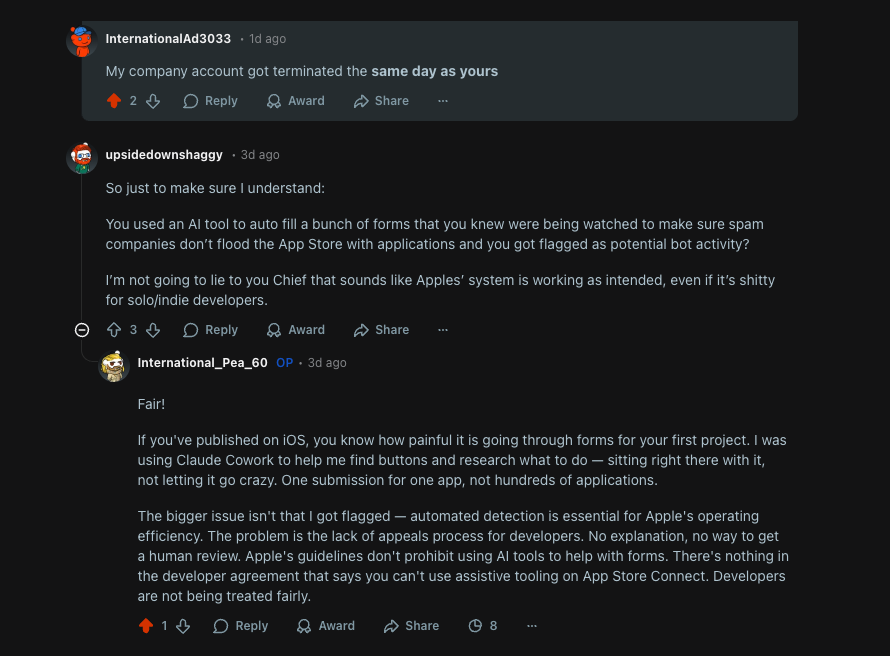
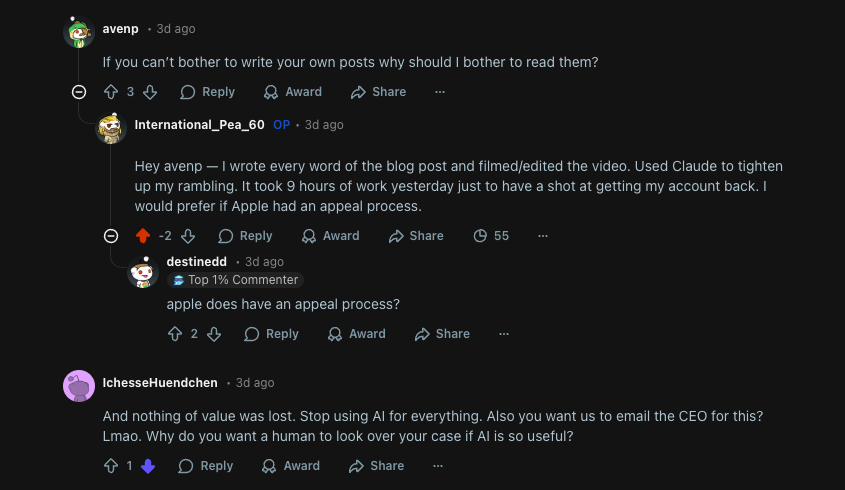
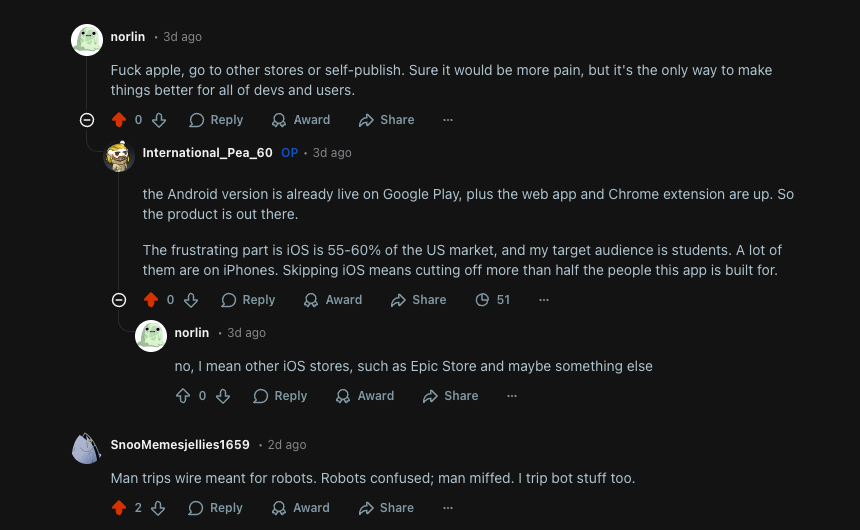
Reddit was brutal — some people in your own community prefer to spit on you when you’re down. r/indiedev was mostly vitriolic. Reddit, it might not be worth it in your case. It was draining, and the tcook@ email + blog post did the real work.
Steel-Manning Apple’s Position
Fraud is a real problem. The economy is weaker than public statistics suggest and desperate people turn to scamming. Apple prevented over $7 billion in fraudulent transactions between 2020 and 2023. Automated detection at scale is reasonable and necessary. But no human review process for false positives is toxic for developer relations.
The Bigger Picture
European developers have real protections. Under the EU’s Platform-to-Business regulation, Apple is required to explain why they terminated an account and provide a real appeals process. The numbers tell the story:
- Apple’s own P2B reports show roughly 12-13% of EU termination decisions get reversed on appeal.
- Globally, the reinstatement rate is 2.8%. That’s a 4-5x difference just because of where you live.
I was skeptical of tech regulation in Europe before this happened. This experience changed my perspective. Apple is dominant digital infrastructure — millions of developers depend on the App Store for their livelihoods. When your automated systems terminate 146,747 accounts a year with no explanation and no meaningful appeal process, you have a duty to do better. The regulatory environment is only going to get worse if they don’t fix this voluntarily. They’re giving ammunition to their critics: EU regulators, the DOJ antitrust case, Epic and Sweeney. Skipping human reviews for account terminations could turn out to be a very expensive strategic mistake.